|
|
|
Prisms
|
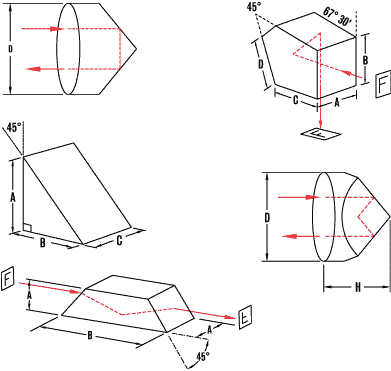
Right Angle Prisms Right Angle Prisms are well suited for beam deviation and retro-reflection. They are often preferable to plane mirrors, because they are easier to mount and align. High throughput is attained when the hypotenuse is used in total internal reflection (TIR), and the entrance and exit surfaces are anti-reflection coated. An incident beam normal to the entrance surface is reflected at a 90° angle.
Read More...
|
Dove Prisms Dove Prisms are used as image rotators in a variety of opto-mechanical systems. They are a truncated form of the right angle prism, and use total internal reflection (TIR) to produce an inverted image which emerges from the exit surface without deviation. As the prism is rotated about its optical axis, the image will rotate at twice the angular rate of the prism. Since the length of the prism is approximately four times the height, the incident light must be parallel or collimated. For applications in which the hypotenuse cannot be kept sufficiently clean for TIR, a metal or dielectric coating can be applied to the hypotenuse.
Read More...
|
Penta Prisms Penta Prisms deviate a beam by 90º without inverting or reversing the image. These prisms also have the property of constant deviation, which means that the 90º deviation angle applies to all rays transmitted by the effective aperture, regardless of their angle with respect to the optical axis. Penta prisms are thus very useful in applications where prism orientation cannot be precisely controlled. Due to the geometry of penta prisms, the reflecting surfaces due not utilize total internal reflection and must be coated with a metal or dielectric coating.
Read More...
|
Porro Prisms Porro Prisms operate on the principle of total internal reflection (TIR). A beam entering perpendicular to the entrance / exit surface is reflected by the two roof surfaces and emerges parallel to itself. For applications in which either the acceptance angle for TIR is exceeded, or the reflecting surfaces cannot be kept sufficiently clean for TIR, a metal or dielectric coating can be applied to the reflecting surfaces.
Read More...
|
Corner Cube Retro Reflectors Corner Cube Retro-Reflectors operate on the principle of total internal reflection (TIR). A beam entering the effective aperture is reflected by the three roof surfaces and emerges from the entrance / exit surface parallel to itself. This property is independent of orientation of the retro-reflector, within acceptance angle limitations. For applications in which either the acceptance angle for TIR is exceeded, or the reflecting surfaces cannot be kept sufficiently clean for TIR, a metal or dielectric coating can be applied to the reflecting surfaces.
Read More...
|
|
|
|
|
|
|
|
Due to their potential strategic high value, export of RMI products and related technical data may be subject to U.S. or other export licensing requirements. Please consult your export control administrator or contact RMI for more information. |
|
|
|
|
|